
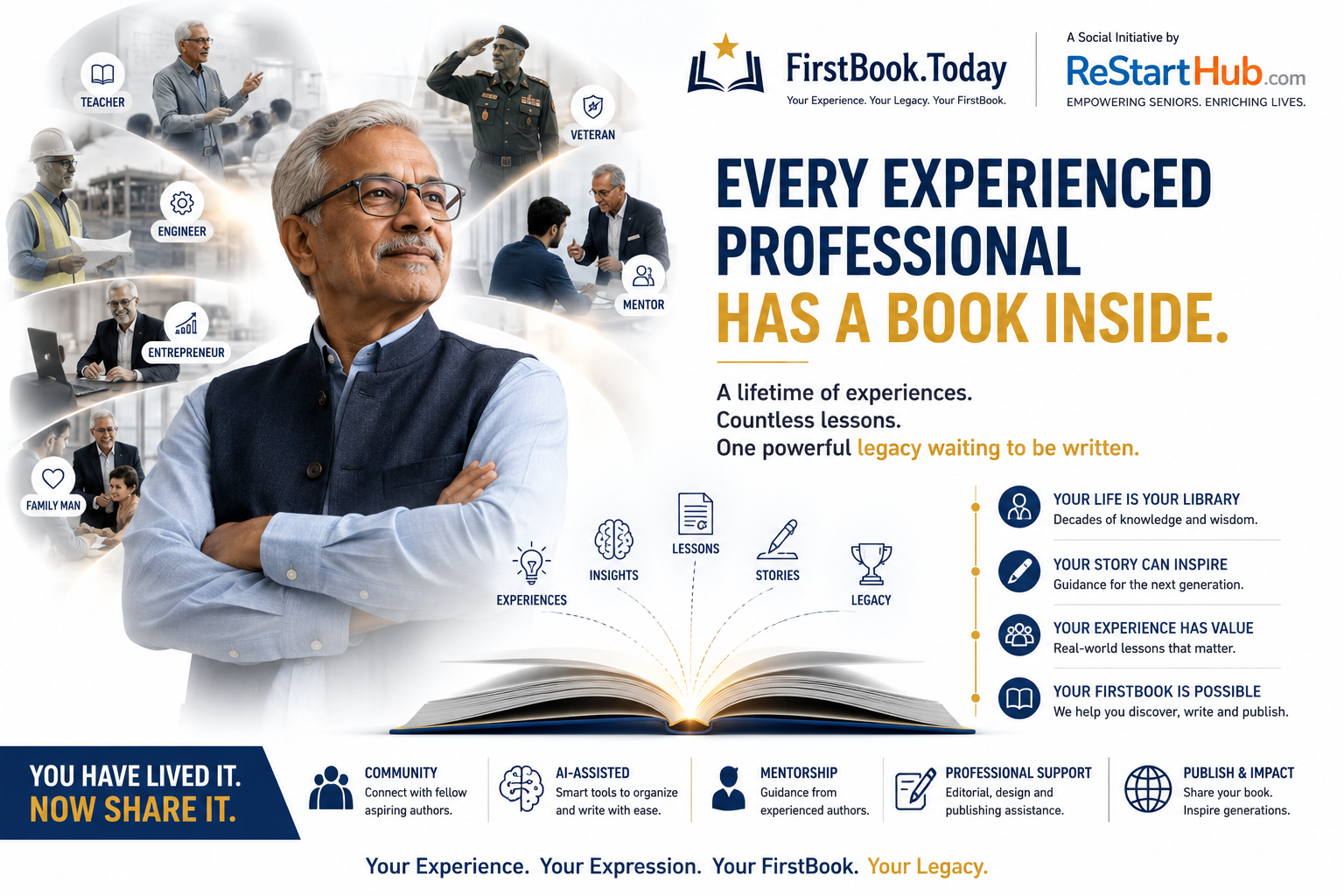
Why First-Time Authors Need an Ecosystem, Not Just a Writing Tool
Quick Answer
Do first-time authors need professional help to write a book?
Not necessarily. Some authors can independently plan, write and publish their books.
However, many first-time authors benefit from the right ecosystem of support, which may include:
- a community of fellow writers;
- mentors and writing guides;
- AI-assisted tools;
- editors;
- designers;
- formatting specialists;
- publishing guidance.
The important principle is simple:
You do not have to do everything yourself in order for the book to remain your book.
Your experience, ideas and voice remain at the center.
The ecosystem simply helps you transform those ideas into a professional result.
That is the philosophy behind the 100xTribe × FirstBook.Today ecosystem.
Writing a Book Can Be Lonely. Creating One Does Not Have to Be.
There is a familiar image of an author.
A person sits alone.
There is a desk.
A laptop.
A blank page.
Perhaps a cup of coffee.
And then comes the intimidating question:
What do I write now?
For an experienced author, this may simply be part of the creative process.
For a first-time author, it can become the point where the journey stops before it begins.
The person may have:
- extraordinary experiences;
- valuable professional knowledge;
- meaningful stories;
- lessons worth sharing.
Yet they may still struggle to answer:
How do I begin?
Then:
How do I organize everything?
Then:
How do I know whether this is any good?
Then:
What happens after I finish writing?
The mistake is assuming that these questions represent a lack of ability.
Often, they simply represent a lack of:
AN ECOSYSTEM.
A Book Is Not Created by Writing Alone
Writing is central to a book.
But creating a professional book often involves many different capabilities.
Think about the journey.
An aspiring author may need to:
- discover the right idea;
- identify the intended reader;
- define the book’s purpose;
- organize experiences;
- create a structure;
- write or record the content;
- review and refine it;
- edit the manuscript;
- design the book;
- format it;
- prepare it for publication;
- introduce it to readers.
That is a lot for one person.
Especially when the person is:
- writing for the first time;
- returning to creative work after retirement;
- unfamiliar with digital publishing;
- learning how AI tools work;
- unsure about the publishing process.
The answer should not always be:
“Learn everything before you begin.”
A better answer is:
Learn what you need to learn. Get support for what requires support.
The First-Time Author’s Biggest Challenge Is Often Not Writing
Many people say:
“I don’t know how to write a book.”
But when you explore the problem more deeply, the actual challenge may be different.
Perhaps they mean:
“I don’t know what my book should be about.”
Or:
“I have too many stories.”
Or:
“I don’t know how to organize my experiences.”
Or:
“I don’t know whether anyone will find this useful.”
Or:
“I am not confident using technology.”
These are different problems.
And they require different kinds of support.
That is why a single writing tool—even an excellent one—cannot solve every challenge.
A meaningful FirstBook journey may require a combination of:
- HUMAN GUIDANCE
- COMMUNITY
- AI-ASSISTED ENABLEMENT
- PROFESSIONAL SERVICES
The FirstBook Ecosystem
At 100xTribe, the FirstBook.Today model can be built around one powerful belief:
Every aspiring author should not be forced to become an expert in every part of publishing.
Instead, the ecosystem can provide access to the right support at the right stage.
The model can be represented as:
AUTHOR
at the center
surrounded by:
- Community
- Mentorship
- AI Tools
- Editorial Support
- Design Support
- Publishing Guidance
The author remains the source.
The ecosystem becomes the enabler.
Layer One: The Power of Community
The first layer is:
YOU ARE NOT ALONE.
A community can make an enormous difference.
Imagine beginning your FirstBook journey alongside people who are also asking:
- How do I start?
- What should my book be about?
- How do I use AI?
- How long should my book be?
- How do I stay motivated?
Suddenly, the journey becomes less intimidating.
Instead of saying:
“I am struggling with this alone.”
You can say:
“Others are learning this with me.”
Introducing the FirstBook Circle
The FirstBook Circle can become one of the most important components of 100xTribe.
A FirstBook Circle could include a small group of aspiring authors who meet regularly to:
- share progress;
- discuss challenges;
- exchange ideas;
- test book concepts;
- celebrate milestones;
- learn new tools;
- encourage one another.
The purpose is not to create pressure.
It is to create:
POSITIVE ACCOUNTABILITY.
A simple question can be powerful:
“What did you do for your book this week?”
Sometimes that question is enough to move an unfinished chapter forward.
Why Community Works
Community creates three important benefits.
1. Belonging
You realize that uncertainty is normal.
2. Accountability
You are more likely to continue when others know what you are trying to achieve.
3. Perspective
Other people can ask questions that help you see your own story differently.
For example, you may casually mention something from your career.
Another member may say:
“That should be a chapter.”
You may never have noticed its importance yourself.
This is one of the hidden benefits of community.
Sometimes others help us recognize the value of our own experience.
Layer Two: Mentorship
A mentor does not write your life for you.
A good mentor helps you ask better questions.
For a FirstBook author, those questions may include:
What is this book really about?
Who is it for?
What problem does it help the reader understand?
Which stories belong in the book?
Which stories should be left out?
What do you want the reader to remember?
The right mentor does not impose a book on the author.
Instead, they help the author discover:
THE BOOK THAT IS ALREADY BEGINNING TO EMERGE.
The Difference Between Advice and Mentorship
Advice often sounds like:
“You should write about this.”
Mentorship asks:
“Why does this matter to you?”
Advice says:
“Make this your first chapter.”
Mentorship asks:
“Where does the reader need to begin?”
Advice can provide direction.
Mentorship helps create understanding.
For experienced professionals, this distinction is particularly valuable.
They may already possess enormous knowledge.
What they often need is not someone to give them more information.
They need someone to help them:
- identify patterns;
- clarify priorities;
- shape meaning.
Layer Three: AI-Assisted Enablement
Technology can create a major barrier.
But it can also remove one.
The goal of FirstBook.Today should be to make AI feel:
USEFUL.
Not intimidating.
Not mysterious.
Not overly technical.
A senior professional does not need to become an AI expert before starting a book.
They simply need to understand:
Which tools can help me at this stage?
How AI Can Support the FirstBook Journey
AI-assisted tools can potentially help with:
Capturing
Turning spoken conversations into text.
Organizing
Grouping scattered notes and ideas.
Exploring
Generating questions that help an author reflect more deeply.
Structuring
Exploring possible chapter sequences.
Improving
Helping review clarity and readability.
Repurposing
Turning selected book ideas into articles, talks or social content.
But the guiding principle remains:
TECHNOLOGY SHOULD REDUCE FRICTION.
IT SHOULD NOT REPLACE AUTHENTICITY.
The AI Confidence Gap
Many senior citizens and experienced professionals may initially feel:
“AI is not for people like me.”
This assumption can create unnecessary exclusion.
The FirstBook ecosystem can help change the experience from:
AI IS COMPLICATED.
to:
AI CAN HELP ME DO THIS.
For example:
Instead of teaching someone every technical concept about artificial intelligence, begin with a practical task.
“Tell your story for five minutes.”
Then:
“Let us see how technology can help turn that conversation into organized material.”
The learning becomes immediately relevant.
That is empowerment.
Layer Four: Professional Editorial Support
Writing a first draft and creating a professional book are not necessarily the same thing.
An author may require different forms of editorial support.
Developmental Support
Helping with:
- book structure;
- chapter sequence;
- clarity of the central idea.
Copyediting
Improving:
- language;
- grammar;
- consistency.
Proofreading
Checking the final manuscript for errors.
Not every author will need every service.
That is why flexibility matters.
The ecosystem should help members understand:
What kind of support do I actually need?
Layer Five: Design and Book Production
Readers often experience a book before reading the first chapter.
They see:
- the cover;
- the title;
- the typography;
- the layout.
A powerful idea can lose impact when the presentation feels careless.
Professional design support may include:
- cover design;
- interior formatting;
- typography;
- digital edition preparation;
- print-ready files.
The goal is not to make every book look expensive.
The goal is to make every serious author feel that their work has been treated seriously.
Layer Six: Publishing Guidance
For many first-time authors, publishing feels like a mysterious final destination.
They may ask:
- Where do I publish?
- Do I need a publisher?
- Can I self-publish?
- How do digital books work?
- What files do I need?
- How do readers discover my book?
These questions can feel overwhelming when asked all at once.
The FirstBook ecosystem can help simplify the journey.
Not every author needs the same publishing path.
The right path depends on:
- goals;
- audience;
- budget;
- format;
- desired level of support.
The important thing is that first-time authors should make informed decisions.
The Three Levels of FirstBook Support
A practical model for 100xTribe could include three pathways.
LEVEL 1: SELF-DIRECTED
For members who want:
- frameworks;
- learning resources;
- community;
- recommended tools.
The member leads the journey independently.
LEVEL 2: GUIDED
For members who want:
- mentoring;
- structured milestones;
- FirstBook circles;
- feedback;
- AI-assisted workflows.
The author remains independent but receives guidance.
LEVEL 3: PROFESSIONAL ENABLEMENT
For members who need specialized services such as:
- editing;
- design;
- formatting;
- production;
- publishing support.
This can become a professional services layer.
One Ecosystem. Different Journeys.
This is important.
Not everyone should be forced into the same program.
One member may be technologically confident but need editorial help.
Another may have excellent stories but need help organizing them.
Another may want to independently write everything.
Another may prefer:
TALKING THEIR BOOK.
The ecosystem should adapt to the author.
Not force every author to adapt to one process.
The FirstBook Support Map
The complete journey can be visualized as:
STEP 1 — DISCOVER
What is my book?
↓
STEP 2 — DEFINE
Who is it for?
↓
STEP 3 — DESIGN
What is the blueprint?
↓
STEP 4 — DEVELOP
How will I create the content?
↓
STEP 5 — REFINE
How can it become stronger?
↓
STEP 6 — PRODUCE
How will it become a professional book?
↓
STEP 7 — SHARE
How will it reach the people it can help?
At every stage, the author should know:
What is my next step?
That clarity alone can prevent overwhelm.
Why Seniors and Veterans May Need a Different Experience
A traditional writing course may assume that everyone:
- is comfortable typing;
- understands digital tools;
- learns at the same speed;
- wants the same type of book.
That assumption can leave valuable people behind.
The FirstBook.Today model should instead be designed around:
ACCESSIBILITY.
This may include:
- voice-first workflows;
- simple instructions;
- patient guidance;
- peer support;
- practical demonstrations;
- human assistance when required.
The objective is not to lower standards.
It is to remove unnecessary barriers.
High Standards. Low Barriers.
This should become a defining philosophy.
We can make it easier to begin.
Without making the final book less professional.
That means:
LOW BARRIER TO START
HIGH STANDARD TO FINISH
A member should be able to start with:
One story.
But potentially finish with:
A professionally developed FirstBook.
The Role of Professional Services
An important distinction must be maintained.
100xTribe does not need to claim that every service is included for every member.
Instead, the ecosystem can:
- educate;
- guide;
- recommend;
- connect;
- enable;
- provide access to appropriate professional support.
This creates a sustainable ecosystem.
The member receives clarity.
Professionals can contribute expertise.
The author remains empowered.
The Author Is Still the Author
This is perhaps the most important principle of the entire model.
If a mentor helps you structure the book:
It is still your book.
If an editor improves your language:
It is still your book.
If AI helps organize your notes:
It is still your book.
If a designer creates your cover:
It is still your book.
Professional support does not remove authorship.
The defining question is:
Whose experience, ideas, insights and authentic voice form the foundation of the work?
The answer should remain:
THE AUTHOR’S.
The 100xTribe Promise
The 100xTribe × FirstBook.Today ecosystem can make a simple promise.
We will not tell you:
“Here is a blank page. Good luck.”
Instead, we aim to help you discover:
- what you have to say;
- who needs to hear it;
- how you can express it;
- which tools can help;
- where professional support may add value;
- how to continue moving forward.
Because writing your FirstBook should not feel like being lost in a forest.
It should feel like following a path.
You may walk it yourself.
But you should know:
YOU ARE NOT WALKING ALONE.
Frequently Asked Questions
Do I need a writing mentor to write my first book?
Not always. Some authors work independently. However, a mentor can help first-time authors clarify their ideas, identify the right audience, structure their book and maintain progress.
Can I use AI to help write my first book?
Yes. AI can assist with tasks such as transcription, brainstorming, organization, outlining and language improvement. However, your personal experiences, facts, judgment and authentic voice should remain central.
What professional services might a first-time author need?
Depending on the project, an author may benefit from developmental editing, copyediting, proofreading, cover design, book formatting, production and publishing guidance.
Can I write a book if I am not comfortable with technology?
Yes. A book can begin with handwriting, conversation, interviews or voice recordings. Technology can be introduced gradually to reduce barriers rather than create them.
Why should I join a book-writing community?
A community can provide encouragement, accountability, feedback, shared learning and a sense of belonging. This can help authors maintain momentum throughout a long creative project.
The Real Meaning of “You Don’t Have to Write Alone”
It does not mean someone else will live your experiences for you.
It does not mean someone else will invent your story.
It means that the difficult journey from:
IDEA
to:
BOOK
does not need to be travelled without support.
You bring:
- your experience;
- your perspective;
- your voice.
The ecosystem can help bring:
- structure;
- tools;
- encouragement;
- expertise;
- professional support.
Together, the transformation becomes possible.
EXPERIENCE
↓
STORY
↓
STRUCTURE
↓
EXPRESSION
↓
MANUSCRIPT
↓
FIRSTBOOK
↓
IMPACT
↓
LEGACY
Your Book May Begin With One Conversation
Perhaps you are still thinking:
“I have no idea where to begin.”
Then do not begin with Chapter One.
Begin with a conversation.
Answer one question:
What is something life taught me that I wish I had known earlier?
Talk about it.
Record it.
Write it down.
Share it with your FirstBook Circle.
Explore it with a mentor.
Use the right AI-assisted tools to organize it.
That single answer may become:
A paragraph.
Then a page.
Then a chapter.
And eventually:
YOUR FIRSTBOOK.
FINAL THOUGHT
For generations, valuable knowledge has disappeared because people believed:
“I am not a writer.”
Perhaps they were never supposed to become writers in the traditional sense.
Perhaps they were always:
- storytellers;
- teachers;
- mentors;
- leaders;
- survivors;
- builders;
- contributors.
The modern ecosystem simply gives them new ways to express what they already know.
That is why FirstBook.Today is not just about writing books.
It is about building:
AN ECOSYSTEM OF EXPRESSION.
Where experience is respected.
Technology is accessible.
Professional excellence is available.
Community provides encouragement.
And every member can begin transforming:
A LIFETIME OF EXPERIENCE
into:
Leave a Reply